‘Don’t Let the Forest In’ by CG Drews – Review
- Published: 29 October, 2024
- Pages: 336 (Kindle Edition)
- Genre(s): Horror, Fantasy, LGBTQ+, Young Adult
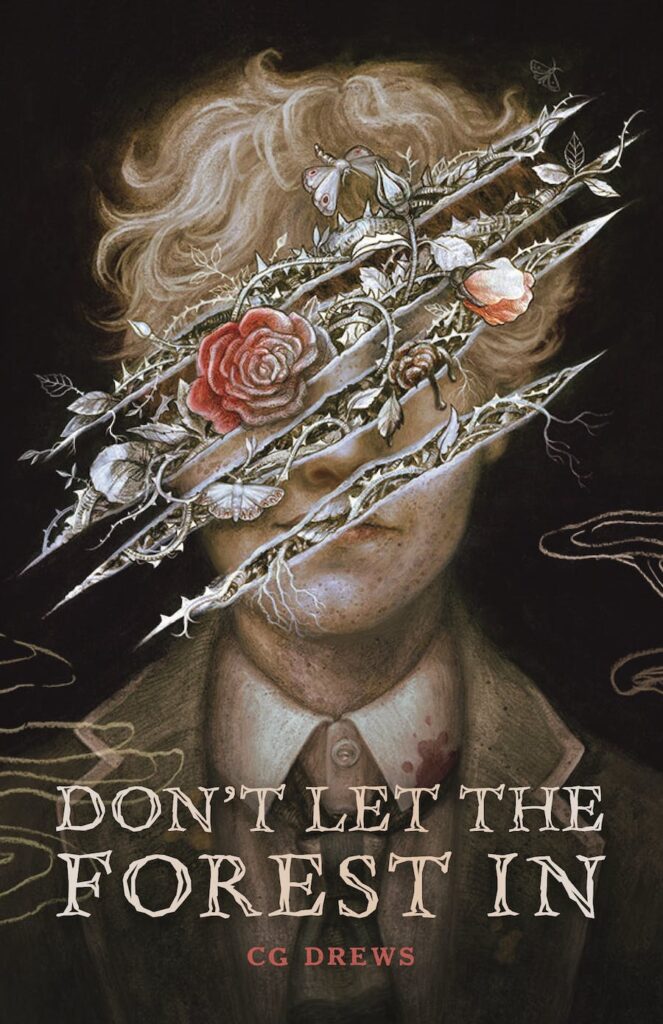
High school senior Andrew Perrault writes his twisted fairytales for Thomas Rye, the only person who can ground him to reality. But when Andrew needs him the most, Thomas suddenly starts acting strange. When Thomas’ abusive parents mysteriously vanish and he arrives to school with blood on his sleeve, Andrew starts to ask questions. However, Thomas only shuts him down, unwilling to discuss what seems to be haunting him. After following him into the woods one night, Andrew finds out that the creatures that Thomas draws – the ones from Andrew’s wicked stories – have come to life, killing anyone close to him. As the boys battle the monsters, Andrew fears that the only way to stop them might be to destroy the one who created them.
I didn’t know what to expect going into Don’t Let the Forest In; I normally don’t gravitate towards the horror genre, but the premise and inclusion of fantasy aspects really enticed me towards this book. Don’t Let the Forest In was so much more than I could have ever wanted, and nothing like anything else I’ve ever read before. The characters were so raw and full of emotion, and although it was a difficult read in many aspects, I truly ended up loving this book.
Grief, Mental Health, and Sexuality
- Grief and mental health are the foremost important themes in this book. I feel like the dialogue on these topics was very effectively done. The metaphor of the forest in particular was very intriguing – the concept of not allowing the “forest” in as an allegory for the grief that Andrew was disallowing himself to feel. As the story progressed, the reasons for the characters decisions became clearer to me and the horror and mystery aspects really added to the urgency that was underlying the entire book.
- I found the book a ‘difficult’ read in the sense that is was very heavy, with sadness imbued into every corner of it, even when the true cause of that sadness was never discussed. In hindsight, I feel that was the exact feeling this book was meant to evoke. Andrew’s perspective is full of disorientation; there are many times where other characters allude to Dove or events in the past, and Andrew responds by brushing those comments aside because he simply doesn’t want to remember. There is so much pain in the act of remembering, and yet not acknowledging what has happened leads to his slow deterioration.
- The true discussion in this book for me was the failure of adults. Every adult in this book filled me with anger, they continuously failed the children as they remained ignorant to their declining mental and physical health. Andrew’s grief was palpable, even with his repressed memories, and his friends could see it and tried time and time again to address it and help him; on the other hand, Andrew’s father, teachers, and the principal of the school ignored his issues and chose to remain oblivious. The adults continuously chose to punish the boys for their actions in response to their declining mental health, instead of helping them in any constructive way.
- Andrew and Thomas’ relationship was fascinating to me. Their every interaction was filled with tension, in both their refusal to acknowledge the elephant in the room – their feelings for one another – and in the guilt felt by Thomas, and anger by Andrew. The progression of their relationship was very interesting as the more they were isolated from the outer world, the more they became obsessed with each other and reliant on their bond. Their obsession with one another even sometimes descended into violence, with each other and others.
- Sexuality was also something that was discussed quite heavily in this novel, Andrew’s asexuality in particular. The GSA present in the school became a way for Andrew to express his thoughts and feelings on his own sexuality to those that he felt might understand him best. Andrew’s asexuality was another part of himself that he felt proved to the world that he was broken. I thought it was a very effective dialogue on asexuality and how asexual individuals might feel about themselves and their identity. The prevalence of sex and romance in society can often leave people who don’t feel the need for them, or don’t have the same thoughts as the average person, quite alienated and there’s not enough discussion about that in non-queer spaces.
Final Thoughts:
I really enjoyed Don’t Let the Forest In and ended up giving it a 5 out of 5 stars. I thought it was unlike anything I have ever read before and thoroughly enjoyed the fantasy aspects, discussion of grief and mental health, and even – unexpectedly – the body horror as an allegory for the former. This book will leave the reader confused, lost, and quite frankly, horrified, and yet they will end up loving every minute of it.